the miracle at speedy motors
Monday, 28 April 2008
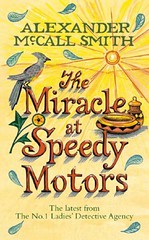 Title :: The Miracle at Speedy Motors
Author :: Alexander McCall Smith
Completed :: Apr 17 2008
Challenges :: The Pub
Rating :: 4/5
Fat lady: you watch out! And you too, the one with the big glasses. You watch out too!
The calm morning which had begun with an obligatory cup of bush tea is suddenly disrupted by the arrival of a threat and all Mme. Matsuki wants to know is how she should file it. Who's threatening the ladies of the No. 1 Ladies' Detective Agency? They couldn't possibly be written by someone in house... could they? This and other mysteries keep Mme. Ramotswe busy but not quite busy enough to distract her from fretting over life's other little worries.
Mr. J.L.B. Matekoni is blinded by the hope of a miracle for his adopted daughter, a miracle that a doctor has said is perhaps possible if he journeys to Johannesburg to see a team of specialists. Mme. Ramotswe is doubtful but hates to steal Mr. Matekoni's miracle especially when she realizes that it is so important to him that he has agreed with the bank to mortgage his garage in order to receive a loan. She steps in however, and secretly provides the money with the sale of her father's precious cattle.
Mme. Matsuki is busy herself dealing with pre-marital grief when the bed she and her fiance picked out is destroyed during a much needed rainfall. (Thank goodness too because a red velvet heart-shaped headboard sounded hideous!)
Once again Smith provides his readers with a novel about the simple things in life. This particular sequel in the series is a bit more laid back, it is less about action and more about enjoying life and being thankful. Everything in the end will be right as rain, Mme. Ramotswe realizes that the biggest miracles in life are often those that are quite small.
Other Thoughts ::
: you're next - reviewed this book? Leave a comment with the link!
. listening . with me tonight . the used . lies for the liars .
Labels: book review
posted by Ashleigh @ 21:24,
,


the uncommon reader
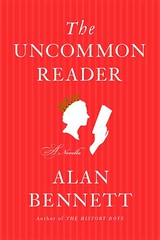 Title :: The Uncommon Reader
Author :: Alan Bennett
Completed :: Apr 16 2008
Challenges :: Novella
Rating :: 5/5
Books are not about passing the time. They're about other lives. Other worlds. A book is a device to ignite the imagination.
If you haven't read this book yet... what are you waiting for? Especially since it will only take you an hour or so to complete. It is deliciously delightful! If Her Majesty were to read a book, what would she read? Does she have time to read?
She'd never taken much interest in reading. She read, of course, as one did, but liking books was something she left to other people. It was a hobby and it was in the nature of her job that she didn't have hobbies.Bennett's novel introduces the Queen to a travelling library parked outside the gates of Buckingham Palace via her pesky barking dogs. In order to be polite the Queen feels that she must check out a book, and does so by selecting a book by Ivy Compton-Burnett that was last checked out in 1989. During the following week she gives the book a gander finding it slightly dull. She uses it as an excuse to skip out on a meeting because the book must be returned. Intending only to hand the book over and be on her way she walks away with Nancy Mitford's novel The Pursuit of Love (so totally bizarre since I myself had just checked this book out the week before this one). She immediately becomes enraptured by Mitford's novel (as I hope I will):
The truth was she didn't really want a book at all and certainly not another Ivy Compton-Burnett, which was too hard going altogether. So it was lucky that this time her eye happened to fall on a reissued volume of Nancy Mitford's The Pursuit of Love. She picked it up. 'Now. Didn't her sister marry the Mosley man?"While her passion for books grows her queenly duties fall to the wayside. What is to become of her public? What does that matter when the Queen feels obligated to catch up with all the good reading she's missed?
'Then of course there was the rather sad sister who had the fling with Hitler. And one became a Communist. And I think there was another besides. But this is Nancy?"
The Pursuit of Love turned out to be a fortunate choice and in its way a momentous one. Had Her Majesty gone for another duff read, an early George Eliot, say, or a late Henry James, novice reader that she was she might have been put off reading for good and there would be no story to tell. Books, she would have thought, were work.
Having finished the Nancy Mitford sequel, Love in a Cold Climate, the Queen was delighted to see she had written others, and though some of them seemed to be history she put them on her (newly started) reading list, which she kept in her desk.
'I think of literature', she wrote, 'as a vast country to the far borders of which I am journeying but cannot possibly reach. And I have started too late. I will never catch up.'Books begin to follow her everywhere, she lives and breathes the written word and even hires an "amanuensis" (one who writes from dictation, copies manuscripts, a literary assistant) - I need me one of these! I think the Queen would seriously be interested in perusing and then tackling the 1001 Books You Must Read Before You Die.
When she finally had to give in and pay some attention to her public she looked for any chance she could to discuss literature. And it would appear Her Majesty is none too fond of the likes of Harry Potter...
... one of her subjects confessed to a fondness of Virgina Woolf or Dickens, both of which provoked a lively (and lengthy) discussion. There were many who hoped for a similar meeting of minds by saying they were reading Harry Potter, but to this the Queen (who had no time for fantasy) invariably said briskly, 'Yes. One is saving that for a rainy day,' and passed swiftly on.I really enjoyed this little gem of a book and will definitely be adding it to my collection if and when I ever have a semi-permanent residence. Just a few last quotes that I could really sympathize with:
What she was finding also was how one book led to another, doors kept opening wherever she turned and the days weren't long enough for the reading she wanted to do.
Can there be any greater pleasure than to come across an author one enjoys and then to find they have written not just one book or two, but at least a dozen?
At it occurred to her (as next day she wrote down) that reading was, among other things, a muscle and one that she had seemingly developed.
Other Thoughts ::
: 1 more chapter
: a striped armchair
: books please
: you're next - reviewed this book? Leave a comment with the link!
. listening . disconnected (out of touch) . trapt . someone in control .
Labels: book review
posted by Ashleigh @ 21:00,
,
the outsider
 Title :: The Outsider
Author :: Albert Camus
Completed :: Apr 15 2008
Challenges :: 1001 Books
Rating :: 3/5
When a man commits a crime and is subsequently put on trial should his emotions, or rather his lack of emotions, in a previous unrelated incident - that of his mother's death take precedence in the eyes of those who judge him? Is Meursault truly an outsider, a stranger to society and the norms of human emotion?
Camus' tale begins with the death of Meursault's mother in a nursing home. He asks for time off from work but only just a day as that is all that is necessary to make the trip down to the nursing home and back. No extra time is requested for Meursault to grieve. During the overnight vigil he appears untouched while the rest of the residents gather to grieve, some crying openly.
It was at that point that I realized they were all sitting opposite me round the caretaker, nodding their heads. For a moment I had the ridiculous impression that they were there to judge me.And perhaps they were, it is Meursault's lack of emotion in this scene that will come back to haunt him. It is also a reflection of what is to come when he will later be seated in court opposite judge and jury.
Since his day off fell on a Friday Meursault did have the weekend to recover only he spent it out and about, even flirting and later making love to a woman the very next day. It is in this relationship that the reader gets tiny hints that Meursault may have some feelings towards others. It is obvious that he's attracted to her, it is obvious that he likes making love to her, he even considers marrying her. But then one must consider whether or not these are merely physical satisfactions vs. an actual emotional investment. Meursault doesn't appear to be too bothered by her while he's in jail. I do however, have to wonder what it was that caused him to commit his crime. The internal dialogue leading up to the criminal act did seem to reflect some sort of emotional quandary. And perhaps this comes to a head at the very end when the chaplain is trying to get him to turn to God. He is annoyed and enraged by this and doesn't understand why indifference is an issue, but suddenly he realizes that the world is indifferent and he embraces that in his last thoughts.
As if that blind rage had washed me clean, rid me of hope; for the first time, in that night alive with signs and stars, I opened myself to the gentle indifference of the world. Finding it so much like myself — so like a brother, really — I felt that I had been happy and that I was happy again. For everything to be consummated, for me to feel less alone, I had only to wish that there be a large crowd of spectators the day of my execution and that they greet me with cries of hate.
Other Thoughts ::
: you're next - reviewed this book? Leave a comment with the link!
. listening . sooner or later . breaking benjamin . we are not alone .
Labels: book review
posted by Ashleigh @ 20:34,
,
the plot against america
Tuesday, 22 April 2008
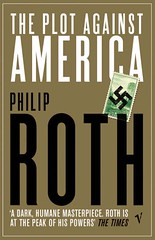 Title :: The Plot Against America
Author :: Philip Roth
Completed :: Apr 11 2008
Challenges :: 888 : 1001 Books
Rating :: 3/5
In The Plot Against America Roth creates an alternative history to 1940s America. In the 1940 election American favorite Franklin Roosevelt is beat out by aviation hero Charles A. Lindbergh. Roth portrays the disappointment and fear of American Jews at Lindbergh's inauguration and the effects his fictional presidency have on American attitudes towards the Jewish population. Although none of the actions in the book can be compared with how the Jewish were treated in Europe, Roth does create a slow penetrating hate. He also hints at America's path towards Jewish concentration camps, used not to murder them but to break them up from the concentrated neighborhoods they lived in, as if perhaps something more sinister was in store for them in the future.
Historically Lindbergh appears to have been an isolationist and believed that the United States had no business involving itself in World War II. Many thought him to be a Nazi sympathizer because of his scientific expeditions to Germany. In a speech titled Who are the War Agitators? given on September 11 1941 at an America First rally, Lindbergh states:
I am not attacking either the Jewish or the British people. Both races, I admire. But I am saying that the leaders of both the British and the Jewish races, for reasons which are as understandable from their viewpoint as they are inadvisable from ours, for reasons which are not American, wish to involve us in the war. We cannot blame them for looking out for what they believe to be their own interests, but we also must look out for ours. We cannot allow the natural passions and prejudices of other peoples to lead our country to destruction.Although Lindbergh would say that "no person with a sense of dignity of mankind can condone such treatment" when referring to how the Jewish population were being treated in Europe he also in that same speech provided a hint at his true feelings when he said, "Their greatest danger to this country lies in their large ownership and influence in our motion pictures, our press, our radio and our government." A statement such as that may lead to the conclusion that Lindbergh feared the power Jewish Americans had and that he was perhaps uncomfortable with it.
Roth uses these speeches in his fictional tale, he also curiously uses himself and his family as the central characters of his book. This gives the reader the feeling that they're actually reading Roth's autobiography and how his Jewish family dealt with America's plunge into isolation. I was unimpressed however, with the way the book ended. I was left with the feeling that the author grew bored and decided to quickly finish so he could move on to something else. A lot of the book as well moves at a fairly slow pace. The plot had real potential if only the pace had been sped up a bit and the conclusion was a bit more well-rounded.
Other Thoughts ::
: puss reboots
: you're next - reviewed this book? Leave a comment with the link!
. listening . wake up . alanis morrissette . jagged little pill .
Labels: book review
posted by Ashleigh @ 13:58,
,
saturday
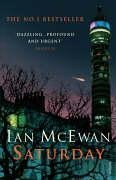 Title :: Saturday
Author :: Ian McEwan
Completed :: Apr 09 2008
Challenges :: 888 : 1001 Books
Rating :: 3/5
Please don't let it happen again. But let me see it all the same, as it's happening and from every angle, and let me be among the first to know.
In a London on the brink of joining the US in a war against terror, Henry Perowne wakes early on a Saturday. Unable to get back to sleep he stands at his window and looks out over a still dark London. In the distant sky he can see a plane coming in, as it grows closer Perowne can see that something is wrong with the plane, one of its engines is on fire and his immediate thought is that terrorists are in action. At a loss as to what to do Perowne continues to watch the plane as it descends towards Heathrow. The sight of the plane will haunt the rest of his day as he goes through it desperate to catch news of it on either radio or TV.
But Perowne has plans for his Saturday, make love to his wife before she goes off to prepare for an upcoming court case, hit the gym and play squash with a fellow neurosurgeon, visit the fishmonger to collect various goods from the sea in order to prepare dinner for his daughter an father in-law who are both visiting from France. The landscape of London is troubled however, a massive rally is scheduled to take place in the streets as protesters gather to voice their opinion about Iraq. Navigating through the streets on his way to the gym, Perowne is suddenly involved in a minor car accident. Little damage is done to either car, Perowne is fine, the passengers in the other vehicle are fine, but what about the other driver? He appears to be fine but is he?
Perowne's encounter with Baxter is on the cusp of becoming violent when Perowne suddenly recognizes symptoms of an oncoming disease in Baxter. He is able to use his knowledge to get him out one tight situation but will it save him later when Baxter pays a visit to the Perowne household?
McEwan draws a wordy yet thoughtful portrayal of one man's thought processes throughout an entire day. I didn't like his choice of narration at first but as the novel moved forward I couldn't imagine it any other way. Perowne's thoughts give the reader a mixture of simple pleasures and the conundrum of facing the state of the world today. I liked the bit with Perowne's daughter, Daisy trying to get her father to read more. She feels that he spent so much time going through medical school that he never had the opportunity to read the classics. During the story he is trying to work his way through Lord Jim and Darwin's Origin of the Species.
Though he's been diligent over the years and tries to read almost everything she puts his way, he knows she thinks he's a coarse, unredeemable materialist. She thinks he lacks an imagination. Perhaps it's so, but she hasn't quite given up on him yet. The books are piled at his bedside, and she'll be arriving with more tonight.Made me think of all the books I've tried to push on my mom. My mom's a reader too, but we both have very different reading tastes and only agree on the occasional book. She surprised me the other day when she said she picked up a copy of Dickens' A Tale of Two Cities - perhaps after having read my review. I was tickled pink, I hope she finishes it though I know she's put it down for awhile.
Other Thoughts ::
: you're next - reviewed this book? Leave a comment with the link!
. listening . perfect lie . sheryl crow . wildflower .
Labels: book review
posted by Ashleigh @ 12:56,
,
the female quixote
Wednesday, 16 April 2008
 Title :: The Female Quixote
Author :: Charlotte Lennox
Completed :: Apr 07 2008
Challenges :: 888 : 1001 Books
Rating :: 5/5
From her earliest Youth she had discovered a Fondness for Reading, which extremely delighted the Marquis; he permitted her therefore the Use of the Library, in which, unfortunately for her, were great Store of Romances, and, what was still more unfortunate, not in the original French, but very bad Translations.
Dear me I absolutely loved this book! So very in the style of Don Quixote, Lennox endows the protagonist, Arabella, with such imagination and such a desire to live in a world and time when men spouted poetry and fell on their swords for the women they loved... only it's not imagination and not a desire... it's real...
Arabella has grown up in the countryside away from the bustle of the crowded streets of London. She spends her days enraptured in the books of romance once belonging to her mother. It is here she learns the great lengths a man must go to for the woman he loves. And don't you dare tell her differently because Arabella is learned and can list countless examples of the trials and tribulations of the great lovers of a long ago generation. She is appalled when a man thinks he can approach her and speak in her presence without first having written a glorious letter, or lie on his death bed awaiting for her to give permission to live.
The adventure really takes off when her cousin Glanville comes to visit. It is made clear by the Marquis that it's his wish for Glanville to marry Arabella and inherit his land. But poor unfortunate Glanville who did not study the great romances makes the ultimate blunder by greeting his cousin with a kiss on the cheek and proclaiming her beauty. How dare he! He is quickly banished from her sight and must jump through hoops to gain back her good graces. In the meantime Sir George Bellmour having seen Arabella's great beauty and learning of her inheritance upon her father's death is determined to win the lady. Bellmour has read the romances, but ignores the fact that they are fiction and uses them to create an outrageous life history of his own which at first intrigues Arabella. Only he makes the mistake of adding one too many love stories and Arabella is appalled by his neglect of his former loves. Bellmour quickly resolves this by involving a young lass to play act a scandal that will throw Glanville into shadow.
I have to give it to Arabella, her life appears far from boring and actually quite tiring. She can barely step out her door without fear of being insulted, repulsed, loved, longed for, ravished or other miscellaneous mishaps. Arabella is virtuous, her speech is flowery and her romantic knowledge knows no bounds. Oh woes me! I'll copy here a little dialogue between Arabella and another poor soul mistakenly identified as a potential lover.
As for Parthenissa, Madam, said he, neither have I heard of her; nor do I remember to have heard of any more than one Cleopatra: But she was never ravished, I am certain; for she was too willing.This discussion so reminded me of one I had at the Benefit make-up counter so long ago in Macy's. I used to work at the visitor center at Biltmore Fashion Park in Phoenix and spent many breaks wandering around the shops. I believe on this occasion I was needing to buy a new Dr. Feel Good (love the stuff) and the cashier and I got to talking. Anyway I must have said something about being an Egyptologist and he totally threw his arms in the air and went "Oh!" and then leaned across the counter with his chin in his hand, batted his eyes and said, "So, was Cleopatra as big of a whore as they say she was?" I about died laughing. Usually people ask me if aliens built the pyramids (which is SO stupid by the way). Ha! Ha!
How! Sir, said Arabella: Was Cleopatra ever willing to run away with her Ravisher?
Cleopatra was a Whore, was she not, Madam? said he.
Hold thy Peace, unworthy Man, said Arabella; and profane not the Memory of that fair and glorious Queen, by such injurious Language: That Queen, I say, whose Courage was equal to her Beauty; and her Virtue surpassed by neither. Good Heavens! What a black Defamer have I chosen for my Protector!
Anyway please read this book because it is a riot, and definitely read it if you loved Don Quixote!
Other Thoughts ::
: you're next - reviewed this book? Leave a comment with the link!
. listening . real love . david gray . a new day at midnight .
Labels: book review
posted by Ashleigh @ 16:50,
,
the first century after beatrice
 Title :: A Century After Beatrice
Author :: Amin Maalouf
Completed :: Apr 06 2008
Challenges :: Novella
Rating :: 4/5
May your name live forever and a son be born to you. - Ancient Egyptian proverb
What would happen if mankind became just that... mankind? Maalouf creates for us a world where the birth of a male heir has become so important that the population of women is dwindling and the world is about to suffer emotional, economical and political repercussions. The title character, Beatrice is born just before the turn of the 21st century and it is her father, an entomologist and nameless narrator, who weaves the tale of how a 'magical' scarab bean begins a worldwide debate on gender bias.
The novel opens with the entomologist being invited to Cairo to present a paper on the scarab beetle at an Egyptology conference. The Egyptologist that speaks after him talks about how the Ancient Egyptians viewed the scarab beetle with its links to reproduction, regeneration, and the journey of the sun across the sky. He mentions the Ancient Egyptian proverb, May your name live forever and a son be born to you and says that even to this day this is a wish of modern Egyptians. He then presents a small wooden box to the audience, its contents contain scarab beans which guarantee the purchaser that if consumed they will give birth to a son. He jokingly adds that the beans cost him $100 and that he wasn't sure if he would be able to claim them as a conference expense. The entomologist is curious and goes to the market, when he finds the beans he is able to purchase them for $10. With a smile he returns to the hotel believing his bargaining skills to be top notch only to realize that his wallet is missing. Annoyed by this blunder he hides the scarab beans in his desk back in France and forgets about them.
It is not until he meets Clarence, a journalist that he falls in love with, that the scarab beans are remembered. While she is away on assignment in India he receives a strange call from her asking to compare the instructions with his scarab beans to those that she has found in a market in India. Her research into small Indian villages as well as Indian hospitals does seem to show proof that female births are declining. The entomologist contacts an old friend and they begin looking into the demographics of several countries. They eventually involve a scientist into their research and it is then that they learn that a company had successfully created a drug to be used in animals to provide male births.
It becomes clear that this drug has been spread across countries such as China, India, Mexico, Africa, and other poorer countries that are over-populated. Eventually these countries begin to collapse economically and their men grow frustrated sexually and are deprived of family life. Violence and rioting break out and there is a veritable scare of girl children being kidnapped.
Maalouf's tale on the surface may seem unbelievable but I was surprised by how easily something of this nature could come about. He mentions high abortion rates in countries such as China, where people are allowed only one child as well as places where male offspring are viewed as important to help with manual labor such as farming. The writing is beautiful and poignant and the arguments for and against gender bias are amazing. I am so glad I snagged this book up and I definitely will be keeping my eye out for more of Maalouf's work.
Other Thoughts ::
: you're next - reviewed this book? Leave a comment with the link!
. listening . simple kind of life . no doubt . return of saturn .
Labels: book review
posted by Ashleigh @ 16:07,
,
the voyage out
 Title :: The Voyage Out
Author :: Virginia Woolf
Completed :: Apr 06 2008
Challenges :: Decades : 1001 Books
Rating :: 3/5
The works of Woolf have so far been hit and miss with me, I enjoyed Mrs. Dalloway but couldn't really get into To The Lighthouse. This novel however, her first, was fun in the beginning especially when the Dalloways make an entrance and stir things up upon the ship of Edwardians heading for South America. But once the Dalloways stepped off the boat before the final destination my interest started to slip. The novel became this void, something was missing, the dialogue was dry and sometimes confusing. There was this monotony of everyday life for the Edwardians staying at the hotel. And there was this complex 'thing' going on between Rachel Vinrace and Terence Hewet. I feel like Woolf was trying to convey something profound and that I just wasn't getting it. So upon finishing I felt relieved but was feeling less than intelligent.
E.M. Forster praised The Voyage Out calling it "a book which attains unity as surely as Wuthering Heights, though by a different path." I'd say quite a different path since I loved Wuthering Heights and felt that the themes were rather clear in that book. Rachel Vinrace came across to me as a person with a deep unhappiness, completely unsure of herself and unwilling to accept that joy and love were things that she could attain. Here Rachel is staring at herself in the looking glass:
In the glass she wore an expression of tense melancholy, for she had come to the depressing conclusion, since the arrival of the Dalloways, that her face was not the face she wanted, and in all probability never would be.This is exactly the kind of attitude that she persists in carrying throughout the novel, she made me feel miserable. What is it that Woolf is trying to portray in this character? Rachel feels an attraction towards Terence and she engages herself to him but then is very wishy-washy about her feelings. Does she actually love him? Does she even understand what love is? I just couldn't seem to find a clear answer in the narrative.
The only thing I can think of is that Rachel was anxious and jumped into a situation that she felt was normal and expected of her. Surely she knew something of love, having been raised by her aunts while her father was out to sea. Her reading however doesn't seem to involve much about love, especially since she is not fan of Austen and has never read her work. Mrs. Dalloway gives her a copy of Persuasion but she ignores it. There's also the weird incident on the ship where Rachel seems to be attracted to Mr. Dalloway or at least his knowledge of the world. Mr. Dalloway picks up on this and following Rachel to her quarters takes her by surprise by kissing her full on the mouth. It is clear that Rachel enjoyed the kiss and I'm made to wonder if she was trying to find that joy again in Terence and became frustrated because it wasn't quite the same.
Well in any case I must give the novel bonus points because in one scene Mrs. Flushing is telling Rachel about the men that used to visit Chillingley, "very clever men interested in Egyptology". Ha! And Hirst's little outburst upon their tour of a South American village, "what an ass I was not to bring my Kodak!" reminded me of all the times I've regretted not having my camera.
Other Thoughts ::
: you're next - reviewed this book? Leave a comment with the link!
. listening . fall line . jack johnson . on and on .
Labels: book review
posted by Ashleigh @ 15:16,
,
miss pettigrew lives for a day
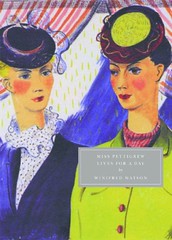 Title :: Miss Pettigrew Lives for a Day
Author :: Winifred Watson
Completed :: Apr 05 2008
Challenges :: 1001 Books
Rating :: 5/5
Ok I waited and I waited and I finally got my hands on the only copy available in all of Liverpool! Definitely worth the wait. When I'm down in London I am visiting the Persephone store and I am walking away with my very own copy of Miss Pettigrew Lives for a Day. Now my only beef is why oh why are they not showing the movie here in the UK? It seems it's being released in Australia next month and Finland gets it in June but no sign of a UK release date. Poo! Guess I'll have to catch it on DVD when I get home and until then I can just read it again!
Miss Pettigrew is a veritable Cinderella with drab clothing, mousy brown hair and not a speck of make-up. The world has been cruel to her and she is alone and unloved. The day she knocked on Delysia Lafosse's door was the day Miss Pettigrew would finally open up to the world and become a beautiful sharp-witted blossom. Expecting to be interviewed as a nanny, Miss Pettigrew's quick thinking soon gets her the unofficial job of Miss Lafosse's social secretary. Within the next few hours Miss Pettigrew has rid Delysia of two pesky lovers, cooked breakfast, drank a few sherries and comforts the salon empress Mrs Dubarry. Miss Lafosse and Mrs Dubarry are over the moon and think Miss Pettigrew has to be the most brilliant woman ever and they are utterly convinced that Miss Pettigrew will be able to bring Mrs Dubarry's quarrelling lover back to his senses. But first, a makeover is a must and new clothes borrowed from Miss Lafosse. Shining and dazzling Miss Pettigrew sweeps through the evening charming everyone she meets, gets a bit tipsy, is a little mischievous and perhaps finds romance.
Absolutely brilliant and a shame that Watson's editor first turned the manuscript down since it was too frothy (I love this word, ever since Danielle used I keep seeing it everywhere) and not nearly as serious as her other books. Thank you Persephone for republishing it and allowing Miss Pettigrew to live one more day!
Other Thoughts ::
: you're next - reviewed this book? Leave a comment with the link!
. listening . smother me . the used . lies for the liars .
Labels: book review
posted by Ashleigh @ 13:54,
,
the prime of miss jean brodie
Monday, 14 April 2008
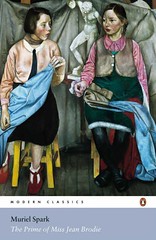 Title :: The Prime of Miss Jean Brodie
Author :: Muriel Spark
Completed :: Apr 01 2008
Challenges :: Novella : 1001 Books
Rating :: 4/5
Give me a girl at an impressionable age and she is mine for life.
So says Miss Jean Brodie, a woman and teacher in her prime willing to lead her girls out in an attempt to make them the crème de la crème. I like that phrase 'to lead out' as a definition of the word education, which Miss Brodie insists that based on its latin roots (and I can't argue since I have yet to learn latin) education means to lead out, as in to bring out what a person already knows. She is adamantly against the headmistress Miss MacKay's idea of education, which is is to put in or as Miss Brodie views it, an intrusion.
Instead of spending their school days learning history, geography, arithmetic and all those other important subjects, Miss Brodie shares with her students tales of her love life, her admiration for Mussolini and art. Because above all she loves art, and she loves the art teacher, Mr. Lloyd. But as he is married he is not perfectly suited for a paramour and so Miss Brodie turns to the music teacher, Mr. Lowther. While carrying on an affair with Lowther and keeping him well fed she begins planning an affair between Mr. Lloyd and Rose, one of the Brodie Set. Rose is a girl known for sex, although I think they mean here sex appeal because she was never described as a hussy running around the town. Rose spends the summer posing for Mr. Lloyd who begins painting a series featuring her, although it is Miss Brodie's profile that graces each frame. Sandy however, another of the Brodie Set sees through these paintings and ends up shocking Miss Brodie when it is she that instigates an affair with Mr. Lloyd. For Miss Brodie was sure that while Rose had the instinct to start an affair it was Sandy that had insight to avoid one.
From the very beginning the reader is aware that at one point Miss Brodie had been betrayed by one of the girls in her set. Miss MacKay was constantly cornering the girls in an attempt to get them to spill some gossip or confession about Miss Brodie that would give her the opportunity to sack her. When that information finally becomes available Miss MacKay confesses to Miss Brodie that it was indeed one of her girls that gave her up. Miss Brodie is shocked but believes that it could have been no other than Mary who was slightly dim-witted and was often used as a scapegoat. But was it she?
I liked how the book was written in a series of flash forwards (sort of like Lost this season) where the reader is aware of the future but is given back history to make sense of the whole picture with bits from the future being revealed here and there. It was nice to know where the girls of the Brodie Set ended up in their adulthood and I have to wonder if they really did become the crème de la crème. I think of all the girls it was probably Sandy that reached that level. She was really 'led out' devoting herself to her religion, becoming a nun and using what knowledge she learned from Miss Brodie to write a book on psychology and psychoanalysis. And yet I still got the feeling that she in the end Sandy was trapped.
I can't help but wonder now if being in one's prime is obvious to a person at the moment it's happening or is it only something you realize once it's regrettably over? Miss Brodie was certain she was in hers, but was she?
Other Thoughts ::
: you're next - reviewed this book? Leave a comment with the link!
. listening . emotional drought . chevelle . this type of thinking could do us in .
Labels: book review
posted by Ashleigh @ 22:55,
,
the yellow wallpaper
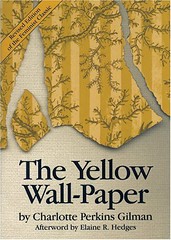 Title :: The Yellow Wallpaper
Author :: Charlotte Perkins Gilman
Completed :: Mar 31 2008
Challenges :: 1001 Books
Rating :: 3/5
I never saw a worse paper in my life. One of those sprawling flamboyant patterns committing every artistic sin. It is dull enough to confuse the eye in following, pronounced enough to constantly irritate and provoke study, and when you follow the lame uncertain curves for a little distance they suddenly commit suicide--plunge off at outrageous angles, destroy themselves in unheard of contradictions. The color is repellent, almost revolting; a smouldering unclean yellow, strangely faded by the slow-turning sunlight. It is a dull yet lurid orange in some places, a sickly sulphur tint in others.
Gilman's short story is based on the journal entries of an American woman in the 19th century. She is brought to live temporarily in a house while she rests from what is diagnosed as a temporary nervous depression but more than likely is postpartum depression resulting from the recent birth of her child. For various reason she and her husband occupy the upstairs nursery and it is here where she is faced with a wallpaper that repulses her and yet draws her into its madness.
The description of the wallpaper is altogether poetic, the language used to describe the protaganist's enticement and fear of this peeling wallpaper, its smell, its allure and its motion is fairly creepy. Is it any wonder under the stress that she was under that she was led to believe that things were trying to come out of the wallpaper? That in the end she went 'mad'? I think what's really creepy is that this is something that really could have happened when women's health was not understood as it is today (or more so anyway). Many women probably suffered from these types of delusions. The mind is very powerful and can create all kinds of scenarios especially when its lonely and misunderstood. It is outrageous to think that it was believed she should rest instead of work, that she should remain isolated instead of engaging in society or that she should be separated from her child instead of trying to be a mother. These things don't lead to recuperation if anything they would make anyone crazier.
My bedroom wall at home has a texturized pattern and I can remember lying awake at times visualizing shapes from the texture. Some shapes were comforting, puppies, pyramids, a teddy bear and then there were some that were frightening - aliens! But luckily for me I didn't go crazy and I was able to remedy those (that I could see) by easily covering them with pillows. Its amazing what the mind's eye can see when it wants to.
Other Thoughts ::
: a striped armchair
: a work in progress
: you're next - leave a comment!
. listening . writing to reach you . travis . the man who .
Labels: book review
posted by Ashleigh @ 18:55,
,
the diary of a nobody
 Title :: Diary of a Nobody
Author :: George & Weedon Grossmith
Completed :: Mar 31 2008
Challenges :: 1001 Books
Rating :: 5/5
Why should I not publish my diary? I have often seen reminiscences of people I have never even heard of, and I fail to see — because I do not happen to be a 'Somebody' — why my diary should not be interesting. My only regret is that I did not commence it when I was a youth.
This was a fantastic read and really made my day! As you may recall I finally stumbled upon a copy the day I decided to make a trek around Liverpool. Sitting at Starbucks on Castle Street I devoured 50 some odd pages and drank a too sweet too spicy iced chai tea latte (I don't think drinking it iced here is a big thing because they never seem to get it quite right). I was giggling and completely unaware if anyone was giving me funny looks not that I would care because it was that good!
Originally appearing as a serial in Punch magazine in 1888 and 1889, George Grossmith provides the witty dialogue of Charles Pooter's diary while his brother Weedon complements it with his drawings. Yes a grown up book with drawings! Love it! So why would anyone want to read the diary of a nobody? Well because that diary of a 'nobody' could very well be filled with witticisms and mocking commentary making the everyday life of a lower middle class man seem extraordinary and filled with moments of delight. In his various ramblings Pooter also displays his social insecurity and how he goes about trying to remedy the view his peers may or may not have of him. Awhile ago I stumbled upon a review that unfortunately I can't find but I wrote down a quote that I liked : "Diary of a Nobody now seems like a startlingly prescient mickey-take of the self-importance of today's bloggers."
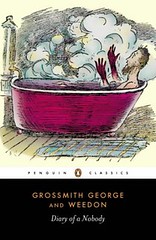
Charles Pooter is a loveable character, his mannerisms are quirky and very realistic. I loved his little obsession with buying various pots of paint to beautify or change the things around him. For example one day he bought a pot of red paint and decided to repaint some terracotta pots, his wife's approval of the change led him to enter the house and begin changing the color of other various furniture. He entered the maid's quarters and decided to paint her bureau red even though she was quite happy with its original shade. Upon entering the bathroom Pooter believed the bathtub to be too white and so decided to paint it red, a mistake he realized later while taking a hot bath. This scene is illustrated on the cover pictured above. He made the mistake of painting his friend's cane black to give it the look of ebony, which made his friend livid after first believing the painted cane to have been a family heirloom. It just little things like these that make this book such a giggle fest.
I also enjoyed the chapter leaders that gave a brief preview of the giggling to come. Here's the leader into chapter 11 as an example :
We have a dose of Irving imitations. Make the acquaintance of a Mr. Padge. Don't care for him. Mr. Burwin-Fosselton becomes a nuisance.and chapter 18:
Trouble with a stylographic pen. We go to a Volunteer Ball, where I am let in for an expensive supper. Grossly insulted by a cabman. An odd invitation to Southend.
Apparently the book has spawned the word "Pooterish" to describe a tendency to take oneself excessively seriously. I see that the book was adapted by BBC twice, the second having only aired last April! I would have loved to have seen this and wonder if it's available on DVD. There's an online weblog version of the diary that pretends 2008 is 1888 and publishes the days accordingly. It might be a fun way to read Pooter's diary although there will be a few days and weeks missing because there were times when Pooter didn't write, and then there were the pages ripped out of his diary and stolen, a mystery to his great frustration never resolved.
Other Thoughts ::
: you're next - reviewed this book? Leave a comment with the link!
. listening . american baby . dave matthews band . stand up .
Labels: book review
posted by Ashleigh @ 18:21,
,
the ladies of grace adieu
 Title :: The Ladies of Grace Adieu
Author :: Susanna Clarke
Completed :: Mar 29 2008
Challenges :: OUT II
Rating :: 3/5
It's been awhile since I've read anything involving faeries, haven't run into any books that fall under that genre in my quest to conquer the 1001. That's why Carl's challenge is so perfect, it inspires me to break from the 'normal' once in awhile and to pick up some of these fantastic books. Doesn't hurt that prizes are involved too! Although I own a copy of Clarke's Jonathan Strange & Mr. Norrell ($5 for the hardback at Borders!) I have yet to read it. I bought it at a time when I had a leaning tower of library books to get through before moving to Liverpool and since the book is rather weighty there was no way it was going to fit in the suitcase. But after reading Ladies of Grace Adieu I definitely want to pick it up when I get home, especially since some of the characters popped up in the pages of these short stories.
I liked how each story was different in its speech. I feel that the accent of a character and the spelling of a piece can really help the reader to imagine the setting. The dialect of On Lickerish Hill took some getting used to but it wasn't hard to eventually fall into the rhythm, the eye learns quickly to gloss over those 'spelling mistakes'. The Suffolk dialect really helped to place oneself in that area of the country, away from the 'proper speech' of London.
I enjoyed the title piece The Ladies of Grace Adieu, which apparently was inspired by a footnote from Jonathan Strange & Mr. Norrell. Three ladies, Cassandra Parbringer, Miss Tobias and Mrs. Field are close friends who in their spare time study magic and have become magicians despite its being a mostly male occupation. When Captain Winbright comes to visit his nieces who are governed by Miss Tobias, it becomes clear that being a loving uncle is not high on his list and that he arrived solely to look into the inheritence involved. The ladies join forces and cause a bit of mischief of their own in order to ensure that the young girls will be safe and that life will contine in Grace Adieu as it always has.
Mrs. Mabb was a charming tale of deception involving a very fine veil between this world and the world of faerie. Venetia returns from a trip to Manchester to find that her beloved Captain Fox is soon to be engaged to another beauty. She becomes determined to see this person for herself and everytime she's given directions (to a different location) she never makes it and ends up badly bruised and cut. It would appear that Venetia is suffering either from dementia or a mischevious faerie has cast a spell over Captian Fox and the eyes of Venetia. I especially loved the episode where she is confronted by what appears to everyone else to be little green butterflies but to Venetia are small little faeries that she becomes determined to squish.
Mr. Simonelli, or the Fairy Widower was another tale involving deception. Alessandro Simonelli is a poor country rector new to Allhope. Upon his arrival he is faced with the task of delivering the baby of John Hollyshoes. Simonelli is repulsed by the shape of the house, it is filthy and utterly disgusting. It soon becomes obvious that he is the only one who can see the truth as others view the house and everything in it as rich and beautiful. Who is this man that wallows in filth and yet appears to be bedecked in jewels? He is a faerie of course and is convinced that he is related in some way to Simonelli and is determined to get to the bottom of it. Written as if from the pages of Simonelli's diary we learn how he tries to save the beautiful ladies of his parish from the dirty Hollyshoes.
Antickes and Frets involves a fictional twist on the imprisonment of Mary, Queen of Scots. When Mary learns that her guardian Bess murdered her first husband through her talent of embroidery, Mary is determined to learn the skill in order to do the same to Queen Elizabeth. This is the second story in the collection involving mischevious embroidery, the first being The Duke of Wellington Misplaces His Horse. This tale takes place in the world created by Neil Gaiman in Stardust. The Duke of Wellington follows his runaway horse through the gap in the wall into the world of faerie. In a cottage he meets a young woman busily at work over her embroidery, which turns out to be blocks portraying everything Wellington did once passing through the wall up to the future which reveals that he will be attacked by a knight who is even now on his way to the cottage. Luckily for Wellington, a pair of embroidery scissors are there to save the day.
Overall a very delightful collection which has put me into the mood of the challenge. Now if only I could located Neil Gaiman's Neverwhere, I seem only to be able to find the graphic novel. Is it the same as the novel?
Other Thoughts ::
: a work in progress
: you're next - leave a comment!
. listening . satellite . dave matthews band . under the table and dreaming .
Labels: book review
posted by Ashleigh @ 11:57,
,
middlemarch
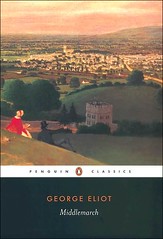 Title :: Middlemarch
Author :: George Eliot
Completed :: Mar 29 2008
Challenges :: 888 : 1001 Books
Rating :: 4/5
What do we live for, if it is not to make life less difficult for each other?
What did Virginia Woolf mean when she described Middlemarch as "one of the few English novels written for grown-up people"? At first I was confused by that statement when I first saw it on the back of the book and still after having read it. But I think what Woolf means is that this isn't a novel full of young headstrong will do anything for love woes me characters. It is a slow potrayal of real life in the 1830s that unfolds at a pace that allows the reader to really get involved in the lives of Eliot's cast. In fact the book's subtitle is A Study in Provincial Life and that's exactly what it is. This book was subject to my post-it method (plotting out how many pages were to be read daily) and thus it became a kind of soap opera for me, minus all the overdramatics. Every day before picking it up I would ask myself, "I wonder what will happen in Middlemarch today". At 838 pages you do become attached and you become sincerely interested in their fates.
There's much too much to summarize here so I will only touch on a few things. I really liked the character of Dorothea Brooke, her devotion to everything she involved herself in was very inspring. Although she had wealth she didn't allow it to blind her to the plight of the farmers living on her uncle's land. She was very interested in redesigning cottages to allow ample space and comfort for these families. She also desired to learn and do great work, though she understood the pains of knowledge, "But it is very difficult to be learned; it seems as if people were worn out on the way to great thoughts, and can never enjoy them because they are too tired" (Amen sister). Unfortunately not many people took her seriously and when a marriage proposal was presented to her that would allow her to aid a clergyman in his scholarly research she accepted even though he was old enough to be her father (and maybe then some). Although her marriage soon became impossible and loveless she stayed utterly devoted to her husband. I think my nerves would have been shot long before her's were. Dorothea is also loyal to her friends and her family. I was especially moved by her desire to help Lydgate remove himself from a scandalous rumor. "People are usually better than their neighbors think they are." I am glad that in the end she received the love and returned devotion she definitely deserved.
I enjoyed the character of Mrs. Garth and the challenges she faced to keep her children educated, something that was very important to her.
She thought it good for them to see that she could make an excellent lather while she corrected their blunder 'without looking' - that a woman with her sleeves tucked up above her elbows might know all about the subjunctive mood or the Torrid Zone - that, in short, she might possess 'education' and other other good things ending in 'tion', and worthy to be pronounced emphatically, without being a useless doll.A lot of Eliot's female characters in this book were strong. It would have been very easy to make Mary Garth into one of those young lovey dovey types but instead Eliot chose to make her practical. She refused to encourage Fred's love for her until he could prove to her that he could be serious and responsible. Although at times I wanted to shout, "would you just tell him you love him already!". I think it was important to Eliot to have all her female characters keep a cool-head and obtain a forceful presence. Even though Rosamond Vincy was a bit narcissistic and headstrong she still kept her head held high through her husband's financial difficulties, she knew what was needed to do to survive.
Upon finishing I felt content, everything was right as rain. It was a satisfying ending with everything resolved and life continuing beyond the pages. I'm curious if being described as an Italian with white mice is a sort of insult. Well I know it was meant as one when it was used by another character to define Ladislaw, and it made me think of Count Fosco in Wilkie Collins' The Woman in White. He was an Italian with white mice, well rats, but he was a crooked character so that must have something to do with it. I also still get a kick out of the prices given in Victorian novels. For example, Lydgate's house cost £90 a year, where my little square of a room cost me about £75 a week! Prices sure have gone up, up, up! The following is a Spanish proverb used to open one of the chapters, I really liked it:
Pues no podemos haber aquello que queremos, queramos aquello que podremos (Since we cannot get what we like, let us like what we can get)
Oh and it seems they're taking Middlemarch to the big screen to be released sometime next year. More info here.
Other Thoughts ::
: a striped armchair
: beastmomma
: you're next - reviewed this book? Leave a comment with the link!
. listening . i miss you now . stereophonics . you gotta go there to come back .
Labels: book review
posted by Ashleigh @ 00:07,
,
crash
Friday, 11 April 2008
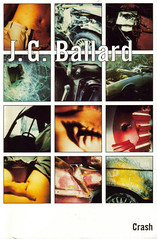 Title :: Crash
Author :: J.G. Ballard
Completed :: Mar 27 2008
Challenges :: Decade : 1001 Books
Rating :: 2/5
...an extreme measure for an extreme situation...
Wow! Well I'm sure this is not a book I would have picked up on my own after reading the back cover. I only read it of course because it's on the 1001 List. As I think I mentioned in an earlier post it was a bit difficult to get through because it is pretty graphic and more than a bit pornographic. I don't think the pornographic bit would have bothered me much (not that I usually read that sort of thing mind you... although those Anita Blake novels tend to get a bit dirty...) but it was mixing it with the element of gruesome deaths and injuries that made it squemish. The element of someone getting off basically while imagining a car crash doesn't do it for me and frankly is a bit frightening. I will say though however, the writing is so graphic that it definitely achieves the picture it is trying to draw. Ballard definitely has a way with words and as this was my first Ballard novel I'm curious to see how his writing style would effect another book of a different nature, since there are a few of his works listed as 1001 contenders.
I thought I would share a bit from the author's note to hopefully give you a better idea of what the novel is about. Mind you the successful movie, Crash starring Brendan Fraser, Sandra Bullock and several other actors is not based on this book although there was a movie of the same title released some time in the 90s starring James Spader.
...I feel that the balance between fiction and reality has changed significantly in the past decades. Increasingly their roles are reversed. We live in a world ruled by fictions of every kind - mass-merchandizing, advertising, politics conducted as a branch of advertising, the pre-empting of any original response to experience by the television screen. We live inside an enormous novel. It is now less and less necessary for the writer to invent the fictional content of his novel. The fiction is already there. The writer's task is to invent the reality.
Throughout Crash I have used the car not only as a sexual image, but as a total metaphor for man's life in today's society. As such the novel has a political role quite apart from it sexual content, but I would still like to think that Crash is the first pornographic novel based on technology. In a sense, pornography is the most political form of fiction, dealing with how we use and exploit each other, in the most urgent and ruthless way.
Needless to say, the ultimate role of Crash is cautionary, a warning against that brutal, erotic and overlit realm that beckons more and more persuasively to us from the margins of the technological landscape.
Other Thoughts ::
: you're next - reviewed this book? Leave a comment with the link!
. listening . me, my yoke and i . damien rice . 9 .
Labels: book review
posted by Ashleigh @ 22:07,
,
a passage to india
 Title :: A Passage to India
Author :: E.M. Forster
Completed :: Mar 24 2008
Challenges :: Decades Challenge : 1001 Books
Rating :: 4/5
My heart is for my own people henceforward.
Another brilliant Forster, makes me wonder why I haven't read any of his work before now! Prejudices and racism are alive and well and are running rampant in this tale of British India. The three main characters, Adela Quested, Dr. Aziz and Cyril Fielding represent very different social circles that weave together the social stratosphere of the time.
Adela Quested arrives in India escorted by Mrs. Moore, both desire to see the real India by escaping the confines of the British commune and Mrs. Moore also hopes to engage Adela to her son, Ronny. Mrs. Moore first meets Dr. Aziz, a native, when she is visiting a mosque at night. Dr. Aziz takes to Mrs. Moore immediately and sees that she's a woman who understands and truly appreciates the local color and isn't afraid to embrace it. A trip to the Marabar Caves is arranged so that Dr. Aziz can show Mrs. Moore and Adela the real India they've been longing to see. Once on the train the ladies find that they are bereft of their male British escorts who incidentally missed the train. They decide to continue as planned hoping they'll catch up. While visiting one of the caves Mrs. Moore is overwhelmed by the sound of the echo and begins to feel a bit claustrophobic causing her to sit out on the rest of the cave exploring. Adela goes off with Dr. Aziz and the local guide to visit a second set of caves. It is here where a set of events takes place that will leave the reader quite confused as to what really happened...
Dr. Aziz is a respected doctor among his Muslim friends. Upon meeting Mrs. Moore in the mosque he becomes interested in getting to know her more as well as act as a guide to his country. He's the kind of man that makes friends easily and wants to be the perfect host. He is adamant about providing a glimpse into the real India and showing Mrs. Moore and Adela around the Marabar Caves even though he himself has never been there. It becomes clear that Dr. Aziz prefers the company of Mrs. Moore over that of Adela who he finds to be a little closed off or as Fielding calls her, a prig. So when Mrs. Moore is unable to continue the tour Dr. Aziz is less than thrilled to continue with Adela, especially when she so boldly asks him whether he has more than one wife. Annoyed by her audacity he sits down to have a cigarette while she explores the caves. When he finishes and goes off to look for Adela, he can't find her until he realizes that she's climbed down the hill to greet a friend in her car.
Whereas Adela represents British society and Dr. Aziz Indian, Fielding provides a type of balance between the two. He sees and understands although doesn't always approve of attitudes on both sides of the rope. I think Fielding's character displays the difficulties that can arise from trying to fit in with the locals when they already have this idea of what 'your people' are like. And on the flip side 'your people' begin questioning your loyalty or your motives. I'd like to think that this is something unique to that time period and situation but I'm afraid it's not. So long as people continue to group people and view them as unavoidably different instead of seeing them as a person like themselves then there will always be these type of feelings.
But what really happened in those caves??? I think I do but I don't want to share it here in case it gives anything away. If you've read the book and have an idea I'd like to hear it.
Other Thoughts ::
: a girl walks into a bookstore...
: my own little reading room
: so many precious books, so little time
: you're next - reviewed this book? Leave a comment with the link!
Labels: book review
posted by Ashleigh @ 21:45,
,
bee season
Friday, 4 April 2008
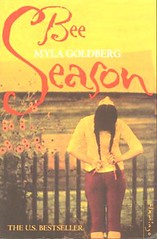 Title :: Bee Season
Author :: Myla Goldberg
Completed :: Mar 22 2008
Challenges :: 888 Challenge
Rating :: 4/5
This was yet another book that for some reason or another I kept passing up but meaning to eventually get to it. That's why I made it part of the 888 Challenge so that I'd finally read it. I think the reason why I liked this novel so much is that the author works with quite a few themes that overlap in such a way that at times it can be difficult to distinguish them because she makes them work so well with one another.
When Eliza wins her class spelling bee and then goes on to win the school and then district spelling bee, her father is relieved that she has finally revealed academic talent. Before only her older brother excelled at school being in all the advanced classes whereas Eliza was not even asked to bother taking the advanced placement test. I think Goldberg makes an excellent attempt here to exhibit parental expectations and the effects they can have on their children. Also the importance of balancing attention between children. Now I'm not a parent but speaking as a 'child' who often became jealous of attentions given to another sibling I know from that perspective equal attention is VERY important. Before it was Eliza who was in a way disregarded because she had no talent where the father put all his efforts into his son. As soon as Eliza's talent appears the father brushes aside Aaron, forgetting their guitar sessions as he focuses solely on harnessing Eliza's talents for something bigger.
Where is the mother in all this? She has a strange relationship with her children, basically she's aloof and throughout the novel is unconnected from the rest of the characters. The one time she attempts to connect with Eliza in the hopes that her daughter in some way is like her, she gives Eliza a kaleidoscope but as Eliza is in 5th grade the toy is unimpressive and the mother is repulsed by this. I don't want to give too much away but let me just say that something very unique is going on with this character. Goldberg creates the perfect illusion and shows that a family can consist of individuals so different they don't even recognize how separate and alone they are. They don't even realize who they are and what's going on with each other except for what's visible on the surface.
This theme is stretched over into the character of Aaron, Eliza's older brother. In the beginning of the novel he starts out as a smart kid, gets along with his family, plays guitar with his dad, a believer in his Judaic upbringing but when Eliza takes center stage as it were, Aaron begins to question his faith. Aaron was always interested in being close to God and while flying across country when he was younger he believes he saw Him in the clouds (though really it was only the red blinking light on the tip of the plane wing). During his Bar Mitzvah Aaron again experiences God but afterwards nothing happens and he begins to get a bit frustrated. After searching through several religions including those of the East, he makes a friend who introduces him to Hare Krishna.
Everything comes to a climax when Aaron finally confesses to his father that he is no longer a Jew and has adopted the orange robes of Hare Krishna. The mother at the same time has been arrested while Eliza secretly sneaks her father's Kabbalistic books in an attempt to speed up her training, afraid to lose her father's approval. You see the spiral and everyone spinning out of control. Only Eliza can set things straight which she does so poignantly.
Goldberg's novel takes such a bizarre twist on everyday life and the quest for perfection through the mediums of a spelling bee, Judiac mysticism, Hare Krishna and a kaleidoscope. Outstanding work for a first novel!
Other Thoughts ::
: you're next - reviewed this book? Leave a comment with the link!
Labels: book review
posted by Ashleigh @ 11:29,
,
the namesake
Tuesday, 1 April 2008
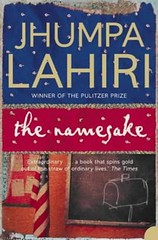 Title :: The Namesake
Author :: Jhumpa Lahiri
Completed :: Mar 20 2008
Challenges :: 888 Challenge
Rating :: 2/5
I really thought I would like this book, maybe I would have but I was too distracted with the mountain of other books I was reading. But now that I have had time to think about it I'm pretty sure that my disappointment stems from the fact that I didn't like the story was told through mostly narration and there was not I feel nearly enough dialogue. At times if felt like reading somebody's boring diary. Bob did this and then he did that and then he said this and then he went there - something like that. It was a nice story but I think it really would have benefited from more dialogue. I still want to see the film and maybe that'll satisfy my need for speech.
The story begins with the birth of the Ganguli's firstborn, a boy. Traditionally the grandmother would give the child it's good name, the name to be used by the rest of the world and on all official documents, the child's intimates would call him/her by a nickname. The Ganugulis however, have a small problem, they now live in America while the rest of their family lives in India. It would be impossible for them to wait at the hospital to receive a letter from the grandmother and the doctor insists that the child cannot leave the hospital without a name on its birth certificate unless the Gangulis wanted it to read Baby Boy. In a moment of inspiration, Ashoke the father decides to name the baby Gogol after his favorite Russian author, Nikolai Gogol (great short stories by the way - loved The Nose). Gogol was meant only to be the baby's nickname until the letter arrived from India. Unfortunately the letter never made it and the grandmother soon passed away. Before Gogol enters kindergarten Ashoke decides to give him the good name Nikhil, a good Bengali name yet close to the name Nikolai. Gogol on the other hand, doesn't like his new name and when his teacher asks him what he prefers to be called he answers Gogol. Thus begins Gogol's love-hate relationship with his name.
As he grows older he doesn't like the fact that his name is different, that it sounds strange, that it is the name of a dead person, a name that is no longer in use. Before entering college he has his name legally changed to Nikhil and sticks with that. It is not until later he learns why his father chose to name him Gogol. When Ashoke was much younger he was traveling on a train to visit his grandfather in India. He had with him an empty suitcase as he knew his grandfather, who shared his love for books, would be parting with some of his collection and gifting them to Ashoke. He also carried with him a well thumbed copy of Gogol's short stories. When the lights went out on the train and the passengers begin to fall asleep Ashoke lay awake reading from Gogol. Before he knew what was happening, he was lying in a field crushed by the weight of the train unable to move. The only thing visible to the rescuers of the derailed train was his copy of Gogol whose pages were fluttering in the wind. If he hadn't had the book in his hand Ashoke is sure that they would have missed him in the wreckage and he would have died. His body was so broken that it took over a year before he could regain any type of mobility and to this day has a drag in his leg.
The book continues through the lives of Ashoke and his wife Ashima as first generation immigrants and their children as they are stuck between two very different cultures and trying to find a happy balance between both. I get the feeling that Gogol was not satisfied with his Indian life or his American life, while it seemed his sister had a better time of integrating into both societies. There didn't really seem to be a happy ending either, it just sort of ended. I can't really remember if there was any solution other than, this is life and that's the way it is. Has anyone else read this book? What did you think?
Other Thoughts ::
: you're next - reviewed this book? Leave a comment with the link!
. listening . ocean size . jane's addiction . up from the catacombs .
Labels: book review
posted by Ashleigh @ 11:53,
,
maus: a survivor's tale
 Title :: Maus: A Survivor's Tale (vol. 1: My Father Bleeds History, vol 2: And Here My Troubles Began)
Author :: Art Spiegelman
Completed :: Mar 13/17 2008
Rating :: 5/5
This was my first venture into graphic novels and I'm glad I chose this particular one. I've been on a World War II kick for some reason, I guess I'm still amazed that something so outrageous, so awful, so life changing happened not that long ago. I like tales of survival that make me question whether or not I would be strong enough to have gone through what they did. This particular Holocaust survival story was different for me because I found it to be raw. It just seems to emit this sense of truth and nothing but the truth, no sugar-coating, no glazing over bits, just telling it how it was. I feel this was doubly achieved by Spiegelman's inclusion of the actual interview process with his father. Its obvious that the two don't exactly get along and get on each other's nerves. Here was the perfect opportunity for Spiegelman to glorify his father, to make is seem like he looked up to him as a hero but instead his graphic novel is blunt, right between the eyes.
The use of animals to represent people I found to be very appropriate on many levels. For one it makes it easier for the reader to distinguish who is who in the panels. The Jews are represented as mice, all looking exactly alike except for individual characters' wardrobe. The use of mice has a double meaning, it shows the Jews as being timid and also as the so-called 'vermin' the Germans announced them to be. The Germans are then shown as cats, the mouse's venerable enemy. The Polish are represented as pigs, something which I read the Polish were not very happy about but I believe Spiegelman counteracted that by saying he chose the pig because it resembled American cartoon characters such as Porky Pig and Miss Piggy. It may have also been a decision based on the fact that the pig plays a big part in the agriculture of Poland. I doubt there were any malicious reasons for choosing the pig since a few Polish characters are shown to be sympathetic to Vladek and his wife Anja. As a clever anecdote Spiegelman depicted Jews wearing pig masks as they walked around pretending not to be Jewish, something which without the use of different animals would have been difficult to portray clearly. Americans are represented as dogs, the French frogs, the British fish and the Swedes reindeer.
I find it ironic that although his father went through this terrible act of prejudice and attempted elimination of an entire 'race' (I put 'race' in quotes because I believe in only one race - the human race) there's a scene in the graphic novel where his father shows his prejudice against blacks. After leaving the grocery store where he successfully returned half eaten food, a black man standing on the side of the road is trying to hitch a ride. Spiegelman's girlfriend pulls over to help him out, immediately his father starts panicing wondering what the heck she's doing. Doesn't she know that these people can't be trusted? That they're theives and for all she knows they could be murdered! Prejudice is a very strong entity and it would seem that not even having survived one of prejudice's worst trials one cand still turn around and be hateful to someone different than them.
Vladek's account of having actually seen and been told how the gas chambers work at Auschwitz I think is probably an important piece of evidence in the history of World War II. After reading Maus I watched Schindler's List and the idea that people knew vaguely what was going on at the concentration camps through rumors but never fully believing that anything so awful could be in existence is perhaps unique to that particular era. I think today people might be more inclined unfortunately to believe such things if they were told, which makes me think what kind of society have we become? We do seem to have the ability to believe more easily in negative things we are told. Does this mean we have become desensitized in first believing in the greater good of mankind? And if so are we better off? Are we more prepared to face the 'evil of our time'? Just something to chew on but it really makes me wonder if this ability to easily believe the worst effects our better judgement when it comes to taking action. Sorry seriously off topic of the book!
As I was saying previously I really enjoyed Spiegelman's window into his life and the life of his father, Vladek. Nothing appears to have been too personal to share, everything is there in print from the death of Spiegelman's younger brother through poisoning to his mother's suicide. Emotions are perhaps clearer utilizing the format of a graphic novel, pure joy at receiving a bar of chocolate (something which I certainly take for granted) becomes much more when you can see it as well as read it. With that being said if you haven't picked up a copy of Maus I suggest you do so. Did I mention the fact that it won a much deserved Pulitzer Prize? I'd like to check out Spiegelman's own account of September 11th, published as In the Shadow of No Towers. I hear that it got mixed reviews but I'd be curious to see how raw this particular account is. From amazon.com: "Spiegelman expresses his feelings of dislocation, grief, anxiety, and outrage over the horror of the attacks---and the subsequent "hijacking" of the event by the Bush administration to serve what he believes is a misguided and immoral political agenda." (and this is what I meant earlier about the dangers of so easily believing in negativity because it can be used against us and thus give consent to the propagation of negativity)
Other Thoughts ::
: 1 more chapter (vol. 1 & vol. 2)
: you're next - reviewed this book? Leave a comment with the link!
. listening . a winter's tale . afi . afi .
Labels: book review
posted by Ashleigh @ 11:52,
,
cold comfort farm
Friday, 28 March 2008
 Title :: Cold Comfort Farm
Author :: Stella Gibbons
Completed :: Mar 13 2008
Challenges :: 888 Challenge : 1001 Books
Rating :: 4/5
This is not a cold book - it is absolutely warm, witty and full of charm. It is a Austen, Waugh and Wodehouse latté! What would you do if your parents passed away leaving you £100 a year (keeping in mind that this was a sufficient fund) and you had absolutely no desire to work? Why you spend a few days in London living it up with your good friend, shopping, theatre-going, dining with attractive men. But then it hits you that although you could care less for employment you do desire to do something good and surely your many relatives in the country are infested with problems that need solving. So you pull out your prettiest stationary and you begin to write to those relatives relaying your sad news and requesting a place to stay. Letters go out to every corner of the country with responses that leave you feeling dull and utterly bored until you open the letter addressed from Cold Comfort Farm...
The beautiful Flora packs her trunk and takes with her a valuable copy of The Higher Common Sense, an essential volume which she hopes will aid her in her stay at Aunt Ada Doom's farm. Judith Starkadder, Flora's cousin and acting matron of the farm responded to Flora's letter saying if she must come then she must come since she owes it to her for what was done to Flora's father (a mystery that is never cleared up in the novel as far as I know). Flora immediately sets to the task of solving the problems of the entire farm, of which there are many. From introducing the maid to the idea of contraception, to making over Elfine so that she can marry her true love, to freeing Judith from her obsession with her son Seth via a physchoanalyst. As people begin to leave the farm to follow their destiny Aunt Ada Doom goes into hysterics, declaring that she saw something in the barn over and over (something which darnit is never explained). Armed with copies of Vogue Flora introduces Aunt Ada Doom to the 20th century and sets her loose into the world, specifically Paris.
The whole book is a riot, I love stories where the main character enters a situation where they try to change and solve everything to the betterment of those involved. The names of the farm cows are also a hoot, Aimless, Feckless, Pointless and Graceless and we musn't forget the bull, Big Business! Absolutely delightful! And I'm so pleased to learn that there is a collection of short stories that act as a sort of prequel titled Christmas at Cold Comfort Farm and a sequel titled Conference at Cold Comfort Farm. I must try to track those down because I have high hopes that they are just as funny as this novel.
Other Thoughts ::
: you're next - reviewed this book? Leave a comment with the link!
. listening . 155 . +44 . when your heart stops beating .
Labels: book review
posted by Ashleigh @ 16:39,
,